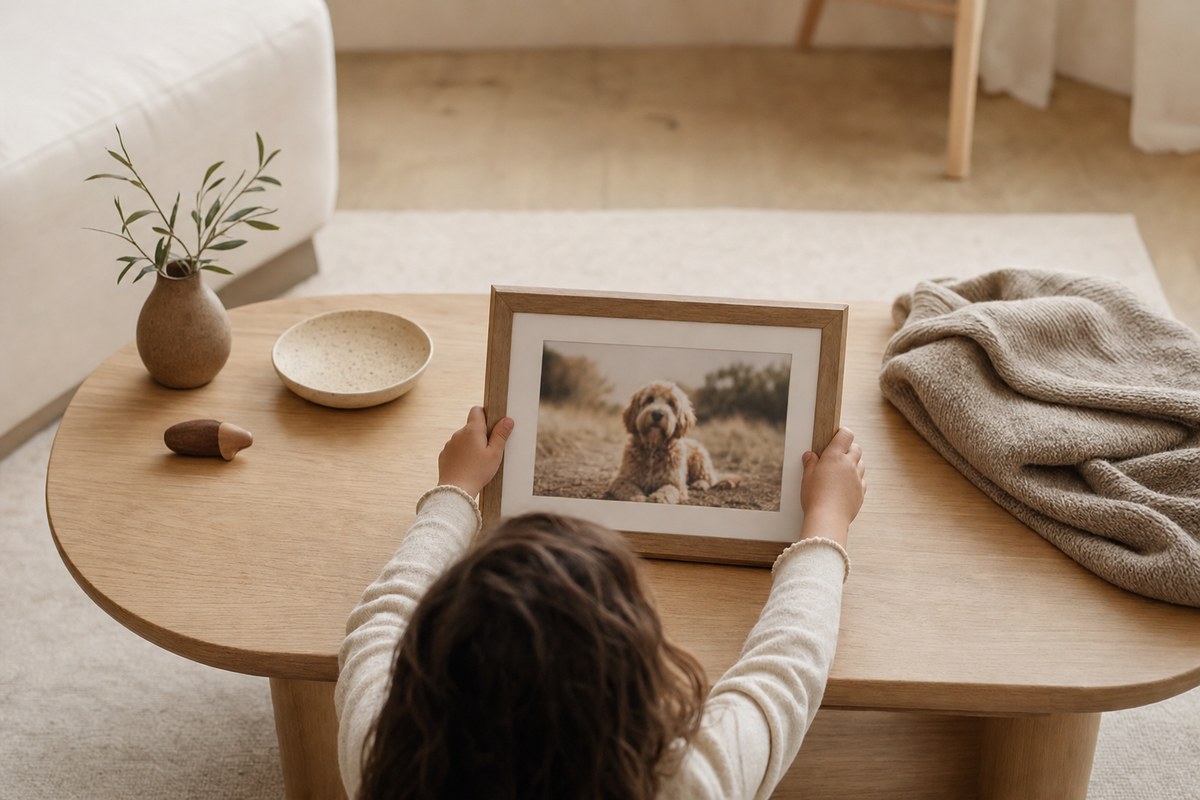
What to Do With Your Pet's Ashes
When a pet's ashes are returned to you, they usually arrive in a plain temporary container, and with them comes a question nobody prepares you for: what now. There is no correct answer, and there is no timeframe you are supposed to meet. Some people know immediately. Many others keep the container on a shelf for months, or years, and that is an entirely reasonable thing to do. This guide sets out the options people commonly consider, so that when you are ready to think about it, the choice feels informed rather than rushed.
At a glance
- There is no deadline. Ashes can stay in their temporary container indefinitely without harm.
- The main options are keeping them at home, scattering, burial, dividing them between people, or a combination.
- Rules for scattering and burial vary by location and by land ownership, so check locally before you commit.
- Dividing ashes between family members is common and lets more than one person hold something.
- A decision can be changed later. Very few of these options are irreversible.
Keeping them at home
The most common choice is simply to keep the ashes, transferred into something you would rather look at than the temporary container. What that something is varies enormously by household. Some people want a piece that reads clearly as a memorial and sits somewhere deliberate. Others prefer something quiet enough that a visitor would not identify it, kept on a bookshelf among ordinary things.
Neither is more respectful than the other. It is worth thinking about where the piece will actually live before choosing it, because size, material and finish all read differently in a bedroom than in a hallway, and a piece that feels right in a shop photograph can feel wrong in the room it ends up in.
If more than one person is grieving
Households do not always agree. One person may want the ashes visible; another may find that difficult. Keeping the ashes somewhere private, and placing a photograph or the collar in the shared room instead, is a compromise that works for many families.
Scattering
Scattering appeals to people whose pet had a place they clearly loved: a beach, a particular walking track, a stretch of garden. Before you plan anything, check the rules for the specific place. Permissions differ between private land, council-managed land, national parks and beaches, and they differ from one local government area to the next. Rules also change over time. The only reliable approach is to ask the body that manages that particular piece of land rather than assume.
Two practical points people often wish they had known. Ashes are heavier and coarser than most people expect, closer to coarse sand than to ash from a fire, and wind matters a great deal, so stand with your back to it. And scattering is final. If there is any doubt in the household, keeping a small portion back is worth considering.
Burial
Burying ashes, either at home or in a dedicated pet cemetery, is a settled and traditional choice. Home burial is subject to local rules that genuinely do vary, and it carries one consideration that is easy to overlook in grief: if you move house, you leave the grave behind. Families who have moved often say this was harder than they anticipated. A pet cemetery avoids that, at a cost, and usually with ongoing arrangements worth reading carefully before signing.
Dividing them
Ashes do not have to go to one place or one person. It is common to divide them, for instance keeping the greater part in one piece at home while a small portion goes into a keepsake for a child who has moved out, or a family member in another city. Small keepsake pieces and pendants designed to hold a token amount exist precisely for this, and they let more than one person have something to hold without anyone having to give the rest up.
This also works well as a middle path when a household disagrees, or when you want to scatter but are not certain enough to part with everything.
Waiting
Doing nothing is a legitimate option and deserves saying plainly, because people are often quietly ashamed of it. There is no harm in leaving ashes in the temporary container while you are not ready. Decisions made in the first weeks after a loss are often revisited, and there is no advantage to reaching one quickly. If someone is pressing you to sort it out, you are allowed to say not yet.
Things people often worry about
- That waiting means they are not coping. It does not; most people wait, and many wait a long time.
- That the container has to be expensive or formal to be respectful. It does not.
- That scattering somewhere public is automatically permitted. It often is not, and rules vary by location.
- That the decision is permanent. Most of these options can be revisited, apart from scattering.
- That they should feel a particular way when the ashes come home. There is no standard reaction.
Conclusion
What to do with a pet's ashes is a personal decision with no timetable attached, and the most common regrets people describe are about rushing it rather than taking too long. If you are struggling, your veterinary clinic can usually point you towards companion animal loss support in your area, and organisations including Grief Australia and GriefLine publish resources specifically on the loss of a pet. Grief after losing an animal is a recognised form of grief, and asking for support with it is a reasonable thing to do.
Frequently asked questions
How long can ashes stay in the temporary container?
Indefinitely. There is no practical or ceremonial reason to move them by any particular time, and many people keep the original container permanently.
Can ashes be divided between family members?
Yes, and it is common. Smaller keepsake pieces and pendants are made to hold a token portion so that several people can each have something.
Am I allowed to scatter ashes at a beach or park?
It depends entirely on the location and who manages the land. Rules differ between councils, parks and private property, so check with the relevant land manager before making plans.
Is it normal to keep ashes for years without deciding?
Yes. Many people never move them, and there is nothing about waiting that indicates a problem.
What do ashes actually look like?
They are generally coarser and heavier than people expect, closer in texture to coarse sand than to fine powder, which is worth knowing before scattering outdoors.